What does it actually take to make a million trading meme coins?
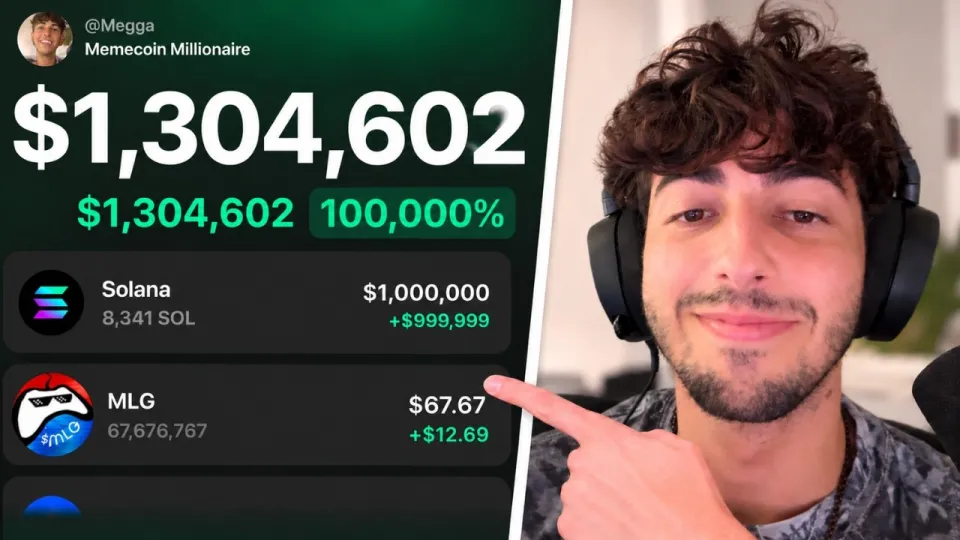
Video: How I Made $1,000,000 Trading Memecoins (FULL BREAKDOWN)
Want articles like this for your own video to promote it on YouTube and Google? Order them through the Telegram bot @sat_sit_bot. Articles with your video embedded are written and posted by the bot itself — on popular topical sites (no ads). Free trial — 50 articles.
· based on the channel Megga
Meme coin trading is a high-risk, zero-sum game where profit comes from being earlier and more disciplined than the crowd, not from fundamentals. Megga, a former Fortnite pro who documented his route to $1,000,000 in meme coin profits, frames it as a grind of thousands of hours in the "trenches" rather than a lucky bet. Beginners who want the structured version of that process can start with the free course linked in the video description, which walks through the basics before any capital is put at risk.
What a meme coin actually is and why it moves so fast
A meme coin is a token with no cash flow, no product and no earnings — its price is pure market sentiment plus liquidity. That is the whole mechanic: supply is usually fixed or trivially inflatable, the entire float can be tiny at launch, and price discovery happens in minutes rather than quarters. Because there is nothing to value, the only questions that matter are who is buying next, how much liquidity sits in the pool, and whether the deployer can drain it.
That structure produces the extremes traders chase. A token launched with a few thousand dollars of liquidity can print a 10x or 100x on a few hundred thousand dollars of buying, and it can round-trip to near zero just as fast when the first large holder sells. Unlike equities or major crypto pairs, there is no circuit breaker, no analyst coverage and no earnings date — only a chart, a contract address and a chat full of strangers.
The trenches workflow: how early entries are actually found
Meme coin profits come from a repeatable pipeline of finding, filtering and exiting new launches, not from one heroic trade. The workflow most consistent traders describe looks like this:
- Source the flow. Watch launchpads, aggregators and wallet-tracking tools for tokens that are minutes old, with a rising holder count and organic buy pressure rather than a single wallet buying in circles.
- Filter the contract. Check whether mint authority is revoked, whether the deployer wallet holds a large share, how concentrated the top holders are, and whether liquidity is locked or burned.
- Size the position. Treat every entry as money that can go to zero; the position size should be small enough that five consecutive losses do not change the plan.
- Plan the exit before entry. Decide what fraction gets sold at 2x, at 5x, and what is left to run — and accept that the runner portion frequently returns to zero.
- Log everything. Track entry market cap, exit market cap, reason for entry and reason for exit, because the pattern only becomes visible across dozens of trades.
Megga's framing of 9-to-12-hour sessions matches this: most of the time is spent reading contracts and charts, and only a small fraction is spent clicking buy.
Risk, rugs and the uncomfortable math of exit liquidity
The uncomfortable truth about meme coins is that gains are funded by other participants' losses, and the fastest way to lose is to be the last buyer of a token someone else is quietly selling. Rug pulls — where a deployer or a coordinated group removes liquidity or dumps a hidden supply — are a structural feature of the market, not an accident. Snipers who buy in the first block and sell into the first wave of retail demand are the other permanent tax on late entrants.
Practical defenses are boring but effective: never buy a token whose liquidity is unlocked, never size a position on a token you cannot read the holder distribution of, and never add to a loser on the theory that it will come back. Phishing is the second front — a single malicious signature can drain a wallet that took months to build, which is why separate hot wallets for trading and storage are standard practice among full-time traders.
Psychology, drawdowns and the 200x trap
Surviving meme coin trading is mostly a psychological problem, because the variance is brutal and the wins are loud. A single 200x on a low-cap can create the illusion that the method works, and the next several positions get oversized in an attempt to repeat it. Drawdowns of 30–50% of a trading stack are normal in this niche; what is not normal is increasing risk after a loss.
The traders who last tend to share three habits: they define a maximum daily loss and stop, they separate trading capital from living expenses entirely, and they treat a losing streak as information about market conditions rather than a personal failure. Motivation from a highlight reel is fine, but the edge comes from the unglamorous middle — showing up, taking the small loss, and not forcing a trade when the flow is thin.
Common questions traders ask before starting
How much capital do you need? Less than people assume for learning, more than people assume for earning. A few hundred dollars is enough to practice entries and exits with real money and real slippage; meaningful income requires a stack large enough that a 20% month is worth the hours.
What if you have a job and cannot watch charts for 12 hours? Then trade fewer, larger-conviction setups instead of scalping launches, and accept a slower curve. Time is the actual input in this niche, so a part-time participant should size expectations accordingly rather than copy a full-time routine.
How do you tell a real narrative from a dead one? Look at whether volume and holder growth persist after the first hype candle, whether the community produces content without being paid, and whether the token survives its first 50% drawdown. Most launches fail that test within a day.
Is networking necessary? It helps. Group chats and streams compress the learning curve because you see other people's mistakes in real time, but no group replaces your own trade log.
Useful links
- Free trading course from Megga
- Low-fee trading platform used in the video
- Megga on Twitch
- Megga on TikTok
- Megga on X
The takeaway
Reaching seven figures trading meme coins is a story about volume of reps, strict position sizing and surviving the stretches where everything goes wrong, not about a secret token. The market is zero-sum and adversarial, so the realistic goal for a new participant is to lose small while learning fast. Megga's breakdown is valuable precisely because it shows the hours and the losses behind the number rather than only the result. If you want the structured starting point, begin with the free course and paper-trade the workflow before committing real capital.
Key takeaways
- Megga, a Fortnite pro turned trader, published a full breakdown of how he reached $1,000,000 in profit trading meme coins.
- The core of the method is long screen hours in the 'trenches' — hunting early low-cap launches on Solana-style launchpads before they trend.
- Profit in meme coins is zero-sum: every dollar won comes from another trader's exit liquidity, which is why rug pulls and snipers dominate the discussion.
- A free course and a low-fee trading platform are linked in the video description as the entry point for beginners.
- Drawdowns are treated as part of the process: consistency and risk limits matter more than a single 200x win.
Source: How I Made $1,000,000 Trading Memecoins (FULL BREAKDOWN) · Markdown version
Questions & answers
How much money do you need to start trading meme coins?
A few hundred dollars is enough to learn the mechanics with real slippage and real fees, which is the point of the first phase. Serious income requires a larger stack, because position sizing has to keep any single loss survivable. Start small and scale only after a documented run of disciplined trades.
Is meme coin trading really profitable, or is it just exit liquidity for early buyers?
Both statements are true at the same time. The market is zero-sum, so aggregate gains equal aggregate losses, and late buyers frequently fund early ones. Profitability for an individual comes from being early, filtering contracts properly and taking profits on the way up instead of holding for a fantasy target.
What is the biggest risk beyond picking a bad token?
Wallet security. A single malicious signature or a phishing link can drain a wallet in seconds, wiping out months of gains. Use a dedicated hot wallet with limited funds for trading, keep the rest in cold storage, and never sign approvals you do not fully understand.
How long does it take to become consistently profitable?
Most full-time traders describe months of screen time before results stabilize, with 9-to-12-hour sessions in the early phase. Consistency comes from a written plan, a trade log and hard loss limits rather than from a single large win. Expect drawdowns along the way; they are part of the process, not proof the method is broken.