Binary options for beginners compared with classic trading and why starting on a demo account with Quotex is the safer first step
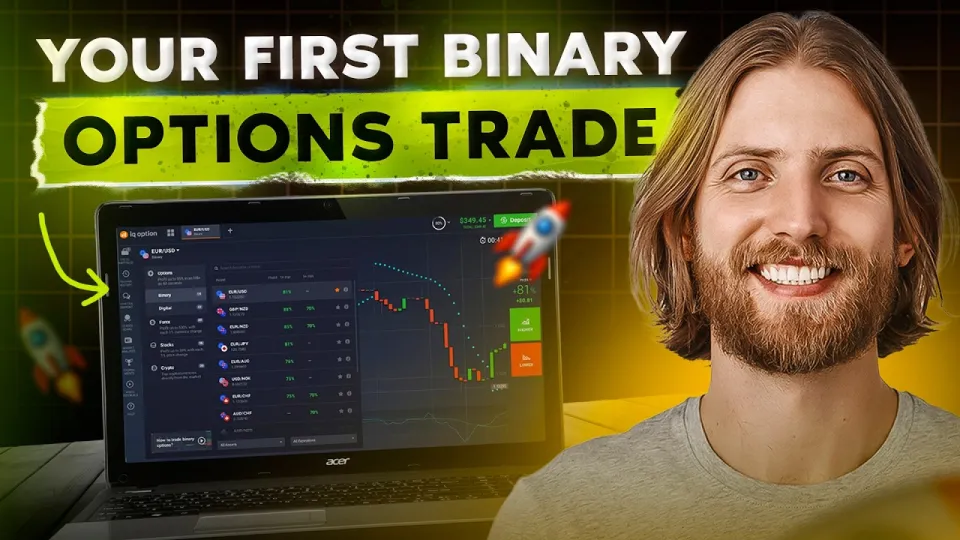
Video: Binary Options | Binary Options Tutorial for Beginners | Where Should You Start?
· based on the channel Binary options tutorial for beginners
Binary options are fixed-risk contracts: you predict whether an asset will be higher or lower at a set expiry, and the payout is known before you click. For a beginner the practical answer is to start on a free demo account — for example by registering on Quotex — and to risk no more than 1–2% of the balance per trade while learning how expiries and payouts interact.
What binary options actually are and how a single trade works
A binary option turns a price forecast into a yes-or-no contract with only two outcomes. You choose an asset (EUR/USD, gold, Bitcoin, a stock index), an expiry time and a direction; the platform locks in the payout percentage at entry, and when the expiry arrives the position closes automatically — there is no stop-loss to move and no position to manage afterwards.
The mechanics in five steps:
- Pick an asset with a tight spread and an active session, such as EUR/USD during the London–New York overlap.
- Choose the expiry: 30 seconds, 1 minute, 5 minutes, or the end of the day, depending on the platform.
- Decide direction — higher (call) or lower (put) than the current price.
- Enter the stake; the potential profit is shown immediately as a fixed percentage of that stake.
- Wait for expiry. In the money returns the stake plus the payout; out of the money loses the stake in full.
Because the loss is capped at the stake, binary options are easy to size. The flip side is that the payout rarely exceeds 100%: typical returns run from about 70% to 95%, and short expiries often pay less than long ones.
Binary options tutorial for beginners and where to start in practice
A beginner's first task is not picking a strategy but understanding the breakeven math and testing it without money at risk. With an 80% payout, a win returns 0.8 of the stake and a loss costs 1.0, so you need to win more than 55.6% of trades just to break even; at 70% the required win rate is about 59%. That number is the real benchmark for any "beginner strategy" — not the size of a winning streak.
A workable first month looks like this:
- Open a demo account and set the virtual balance to the amount you would realistically deposit.
- Trade one asset only, at one expiry only, so that results are comparable.
- Keep a log of every trade: asset, expiry, direction, reason for entry, result.
- After 50–100 demo trades, calculate the actual win rate and compare it with the breakeven threshold for the payout you were getting.
- Only after that consider a small live deposit, with risk per trade of 1–2% of the balance.
Quotex vs Pocket Option vs Binarium for a first account
The three platforms most often recommended to newcomers differ mainly in interface, minimum deposit and asset list rather than in the underlying contract. Quotex is known for a clean, fast interface and a low entry threshold, which suits people who want to place a first trade within minutes. Pocket Option adds social trading features and a wider set of account types, and Binarium has historically positioned itself around a broader asset menu and longer expiries.
What matters more than the brand is what you check before depositing:
- Minimum deposit and minimum stake, since these determine how long a small balance lasts.
- Payout percentages on the assets and expiries you actually intend to trade.
- Whether a demo account is unlimited and resets, so practice is not cut short.
- Withdrawal methods, processing times and any fees or minimum withdrawal amounts.
- Regulation and jurisdiction: binary options are restricted or banned for retail clients in several countries, including the EU and the UK, so availability depends on where you live.
Risk rules that separate a test from gambling
Position sizing is the single rule that keeps a beginner in the game long enough to learn. With 1% risk per trade, ten consecutive losses cost about 10% of the balance; with 10% risk, the same streak wipes out two-thirds of the account and recovery becomes mathematically far harder.
Practical guardrails:
- Cap daily loss at 5% of the balance and stop trading when it is hit.
- Avoid martingale doubling after a loss; it converts a small edge problem into an account-ending one.
- Trade during liquid sessions, because thin markets make short expiries behave like coin flips.
- Treat every payout below 70% as a warning sign: the win rate required to break even rises sharply.
Typical beginner questions and doubts
Most hesitation around binary options comes down to three things: whether the payout is fair, whether a short expiry can be predicted at all, and whether a demo account really prepares anyone for live trading. On payouts, the honest answer is that the platform's edge is built into the percentage, so the trader's job is to find setups whose win rate clears the breakeven line. On expiries, a 30-second contract is driven mostly by noise, while 5-minute to end-of-day contracts leave room for a readable trend or news reaction. On demo versus live, the difference is emotional rather than technical — the same clicks feel different with real money, which is why the first live stakes should be the smallest the platform allows.
All platforms and tools mentioned
- Quotex — open the registration page
- Pocket Option — platform website
- Binarium — platform website
- NordVPN — VPN service
Summary
Binary options are simple to execute and hard to win at consistently, because the fixed payout sets a breakeven win rate of roughly 56–59% before a trader earns anything. The sensible route for a beginner is a demo account on a platform such as Quotex, one asset and one expiry at a time, a written trade log, and risk of 1–2% per trade once real money is involved. This breakdown accompanies the video guide from the channel Binary options tutorial for beginners, which walks through the same starting sequence. To put it into practice, start with a Quotex account and run the demo before depositing anything.
Key takeaways
- Binary options fix the payout before the trade: a correct call returns a set percentage, typically 70–95%, while a wrong one loses the full stake.
- The expiry is chosen before entry — commonly 30 seconds, 1 minute, 5 minutes or end-of-day — and the trade closes automatically at that moment.
- Three platforms dominate beginner tutorials: Quotex, Pocket Option and Binarium, all offering demo accounts before real deposits.
- A 70% payout requires roughly a 59% win rate just to break even, which is why risk per trade should stay near 1–2% of the balance.
- Demo trading on Quotex is free and uses virtual funds, so a beginner can test an expiry and asset without risking capital.
Source: Binary Options | Binary Options Tutorial for Beginners | Where Should You Start? · Markdown version
Questions & answers
How much money do I need to start trading binary options?
Many platforms accept deposits from around $10, and minimum stakes are often $1, so a first live account can be small. The more useful rule is that a single trade should be 1–2% of the balance, which means a $100 account should risk $1–2 per trade, not $10.
Can binary options be profitable with a 70% payout?
Yes, but the bar is high: at a 70% payout you need to win about 59% of trades just to break even, and more than that to profit. That is why traders prefer assets and expiries with payouts of 80–95% and track their win rate over at least 50 trades.
Is a short expiry like 30 seconds easier for a beginner?
Usually not. Very short contracts are dominated by random price noise, so skill has little room to show up. Expiries of 5 minutes to end-of-day give a trend or a news reaction time to play out and are generally easier to reason about.
Do I need a VPN to use these platforms?
Only if binary options are restricted in your country, and even then a VPN does not change the legal position or the platform's terms of service. Check local rules first, since retail binary options are banned in several major jurisdictions.